ReSWD: ReSTIR‘d, not shaken. Combining Reservoir Sampling and Sliced Wasserstein Distance for Variance Reduction.
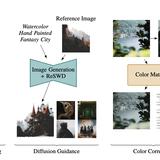
Distribution matching is central to many vision and graphics tasks, where the widely used Wasserstein distance is too costly to compute for high dimensional distributions. The Sliced Wasserstein Distance (SWD) offers a scalable alternative, yet its Monte Carlo estimator suffers from high variance, resulting in noisy gradients and slow convergence. We introduce Reservoir SWD (ReSWD), which integrates Weighted Reservoir Sampling into SWD to adaptively retain informative projection directions in optimization steps, resulting in stable gradients while remaining unbiased. Experiments on synthetic benchmarks and real-world tasks such as color correction and diffusion guidance show that ReSWD consistently outperforms standard SWD and other variance reduction baselines.
SViM3D: Stable Video Material Diffusion for Single Image 3D Generation
In ICCV
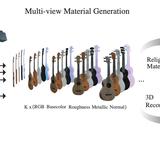
We present Stable Video Materials 3D (SViM3D), a framework to predict multi-view consistent physically based rendering (PBR) materials, given a single image. Recently, video diffusion models have been successfully used to reconstruct 3D objects from a single image efficiently. However, reflectance is still represented by simple material models or needs to be estimated in additional pipeline steps to enable relighting and controlled appearance edits. We extend a latent video diffusion model to output spatially-varying PBR parameters and surface normals jointly with each generated RGB view based on explicit camera control. This unique setup allows for direct relighting in a 2.5D setting, and for generating a 3D asset using our model as neural prior. We introduce various mechanisms to this pipeline that improve quality in this ill-posed setting. We show state-of-the-art relighting and novel view synthesis performance on multiple object-centric datasets. Our method generalizes to diverse image inputs, enabling the generation of relightable 3D assets useful in AR/VR, movies, games and other visual media.
MARBLE: Material Recomposition and Blending in CLIP-Space
In CVPR
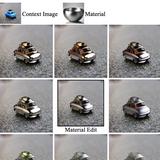
Editing materials of objects in images based on exemplar images is an active area of research in computer vision and graphics. We propose MARBLE, a method for performing material blending and recomposing fine-grained material properties by finding material embeddings in CLIP-space and using that to control pre-trained text-to-image models. We improve exemplar-based material editing by finding a block in the denoising UNet responsible for material attribution. Given two material exemplar-images, we find directions in the CLIP-space for blending the materials. Further, we can achieve parametric control over fine-grained material attributes such as roughness, metallic, transparency, and glow using a shallow network to predict the direction for the desired material attribute change. We perform qualitative and quantitative analysis to demonstrate the efficacy of our proposed method. We also present the ability of our method to perform multiple edits in a single forward pass and applicability to painting.
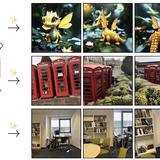
Stable Virtual Camera: Generative View Synthesis with Diffusion Models
In ICCV
We present Stable Virtual Camera (Seva), a generalist diffusion model that creates novel views of a scene, given any number of input views and target cameras. Existing works struggle to generate either large viewpoint changes or temporally smooth samples, while relying on specific task configurations. Our approach overcomes these limitations through simple model design, optimized training recipe, and flexible sampling strategy that generalize across view synthesis tasks at test time. As a result, our samples maintain high consistency without requiring additional 3D representation-based distillation, thus streamlining view synthesis in the wild. Furthermore, we show that our method can generate high-quality videos lasting up to half a minute with seamless loop closure. Extensive benchmarking demonstrates that Seva outperforms existing methods across different datasets and settings.

SPAR3D: Stable Point-Aware Reconstruction of 3D Objects from Single Images
In CVPR
We study the problem of single-image 3D object reconstruction. Recent works have diverged into two directions: regression-based modeling and generative modeling. Regression methods efficiently infer visible surfaces, but struggle with occluded regions. Generative methods handle uncertain regions better by modeling distributions, but are computationally expensive and the generation is often misaligned with visible surfaces. In this paper, we present SPAR3D, a novel two-stage approach aiming to take the best of both directions. The first stage of SPAR3D generates sparse 3D point clouds using a lightweight point diffusion model, which has a fast sampling speed. The second stage uses both the sampled point cloud and the input image to create highly detailed meshes. Our two-stage design enables a probabilistic modeling of the ill-posed single-image 3D task, while maintaining high computational efficiency and great output fidelity. Using point clouds as an intermediate representation further allows for interactive user edits. Evaluated on diverse datasets, SPAR3D demonstrates superior performance over previous state-of-the-art methods, at an inference speed of 0.7 seconds.
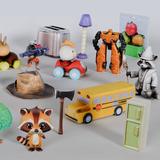
SF3D: Stable Fast 3D Mesh Reconstruction with UV-unwrapping and Illumination Disentanglement
In CVPR
We present SF3D, a novel method for rapid and high-quality textured mesh reconstruction from a single image. Utilizing the Large Reconstruction Model (LRM) as its foundation, SF3D achieves fast generation times with detailed, textured meshes in just 0.5 seconds. Unlike traditional approaches, SF3D is explicitly trained for mesh generation, incorporating a fast UV unwrapping technique that enables swift texture generation rather than relying on vertex colors. The method also learns material parameters and normal maps to enhance the visual quality of the reconstructed models. Furthermore, SF3D integrates a delighting step to effectively remove low-frequency illumination effects, ensuring that the reconstructed meshes can be easily used in novel illumination conditions.
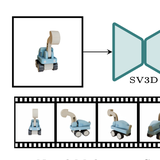
SV3D: Novel Multi-view Synthesis and 3D Generation from a Single Image using Latent Video Diffusion
In ECCV
We present Stable Video 3D (SV3D) - a latent video diffusion model for high-resolution, image-to-multi-view generation of orbital videos around a 3D object. Recent work on 3D generation propose techniques to adapt 2D generative models for novel view synthesis (NVS) and 3D optimization. However, these methods have several disadvantages due to either limited views or inconsistent NVS, thereby affecting the performance of 3D object generation. In this work, we propose SV3D that adapts image-to-video diffusion model for novel multi-view synthesis and 3D generation, thereby leveraging the generalization and multi-view consistency of the video models, while further adding explicit camera control for NVS. We also propose improved 3D optimization techniques to use SV3D and its NVS outputs for image-to-3D generation. Extensive experimental results on multiple datasets with 2D and 3D metrics as well as user study demonstrate SV3D’s state-of-the-art performance on NVS as well as 3D reconstruction compared to prior works.
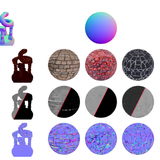
Collaborative Control for Geometry-Conditioned PBR Image Generation
In ECCV
Current 3D content generation builds on generative models that output RGB images. Modern graphics pipelines, however, require physically-based rendering (PBR) material properties. We propose to model the PBR image distribution directly to avoid photometric inaccuracies in RGB generation and the inherent ambiguity in extracting PBR from RGB. Existing paradigms for cross-modal finetuning are not suited for PBR generation due to a lack of data and the high dimensionality of the output modalities: we overcome both challenges by retaining a frozen RGB model and tightly linking a newly trained PBR model using a novel cross-network communication paradigm. As the base RGB model is fully frozen, the proposed method does not risk catastrophic forgetting during finetuning and remains compatible with techniques such as IPAdapter pretrained for the base RGB model. We validate our design choices, robustness to data sparsity, and compare against existing paradigms with an extensive experimental section.
SHINOBI: Shape and Illumination using Neural Object Decomposition via BRDF Optimization In-the-wild
In CVPR
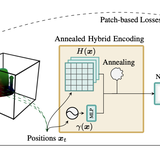
We present SHINOBI, an end-to-end framework for the reconstruction of shape, material, and illumination from object images captured with varying lighting, pose, and background. Inverse rendering of an object based on unconstrained image collections is a long-standing challenge in computer vision and graphics and requires a joint optimization over shape, radiance, and pose. We show that an implicit shape representation based on a multi-resolution hash encoding enables faster and robust shape reconstruction with joint camera alignment optimization that outperforms prior work. Further, to enable the editing of illumination and object reflectance (i.e. material) we jointly optimize BRDF and illumination together with the object’s shape. Our method is class-agnostic and works on in-the-wild image collections of objects to produce relightable 3D assets for several use cases such as AR/VR, movies, games, etc.